
Now we talk about the extremely exciting topic of weather. Everyone's favorite small talk around the office, and by far the single most important topic of our entire game. /s
Weather Cells
Weather is based on weather cells, or "wcells", that staff can setup in the game. A weather cell is a way to group places together that share the same weather. This can be an entire area, or just a district inside an area, or even specific rooms. See this previous devblog discussing Ursun's implementation of areas.
Within a wcell we can set the following parameters:
- max wind
- max and min temperature
- max condition (condition is how much sand the air contains)
- neighboring cells (and how strongly they pull on each other)
The weather of any given room is determined by a simple hierarchy. The game first checks to see if the room has a specific wcell for it. If there isn't one, it then checks to see if the room is part of a district. If it isn't, then it checks to see if the room is part of an area. So it goes from more specific to more broad when determining the exact conditions in a room.
Borders
In the old ArmageddonMUD game, a character could move from one zone to another and suddenly find the weather very different. In Tales of Zalanthas all of the rooms in the border area between wcells will blend the weather, so that the transition from one pattern to the next feels more natural.
An individual wcell can pull a neighboring wcell, and their patterns will bleed into each other. The links between wcells have a strength value, and a wcell with fewer neighbors feels each of them more strongly.
Weather "Flower"
The heart of the system is based on a hex flower, which is an idea borrowed from tabletop RPGs, though it doesn't follow that pattern exactly. A typical hex flower is a cluster of hexagons where you don't roll on a table so much as walk around it, a single hex at a time. The larger hex is usually divided into 19 smaller ones in a 3-4-5-4-3 pattern.
We've taken the core idea and simplified it a bit for our purposes, with only 12 hexes, arranged as a ladder of five rows climbing from calm weather at the bottom to the worst at the top.
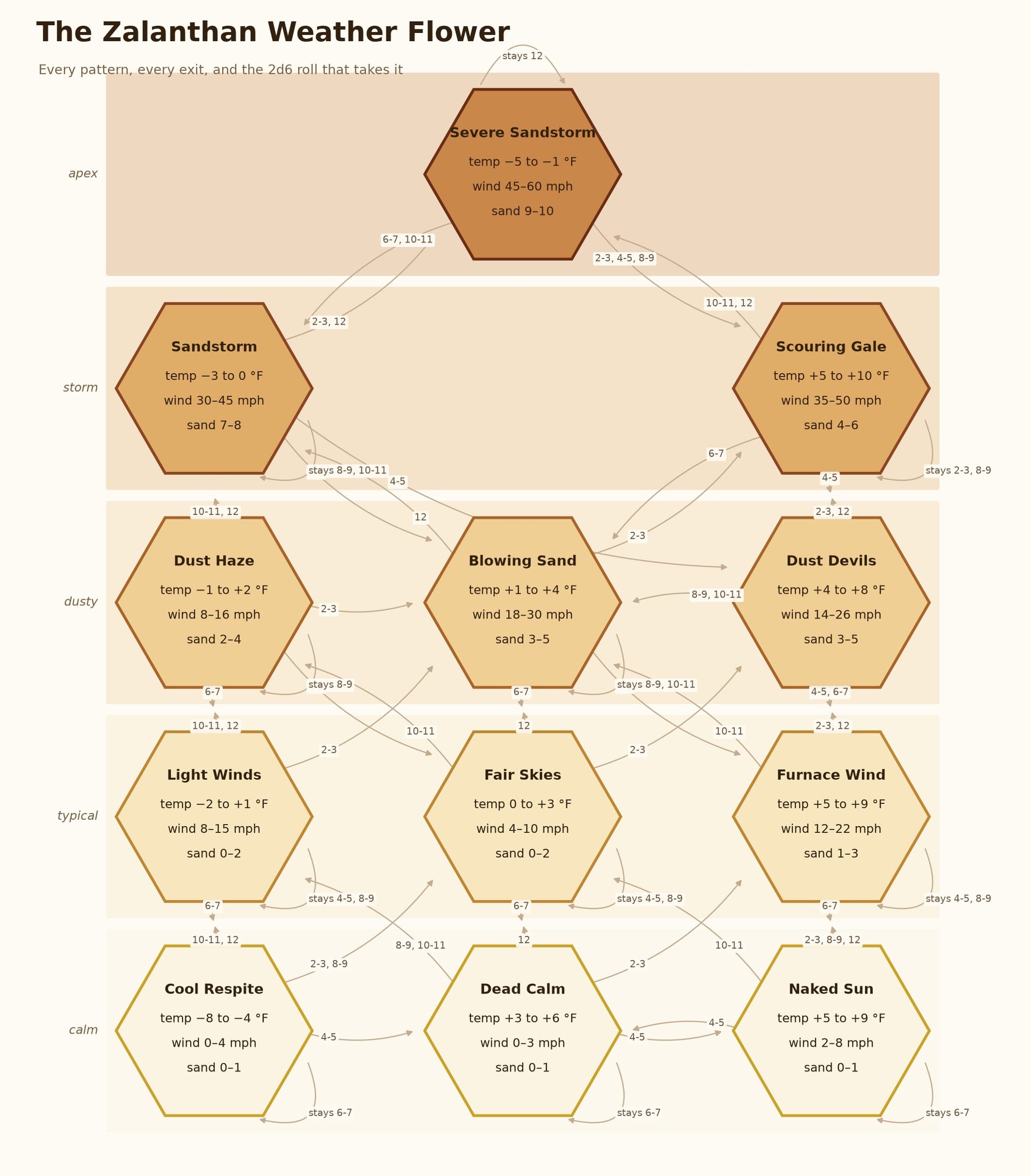
Movement on the flower cannot "jump" more than one row of severity at a time, instead the chance to move to another hex is based on a 2d6 roll. This means that certain directions (or choices) are more likely to occur than others.
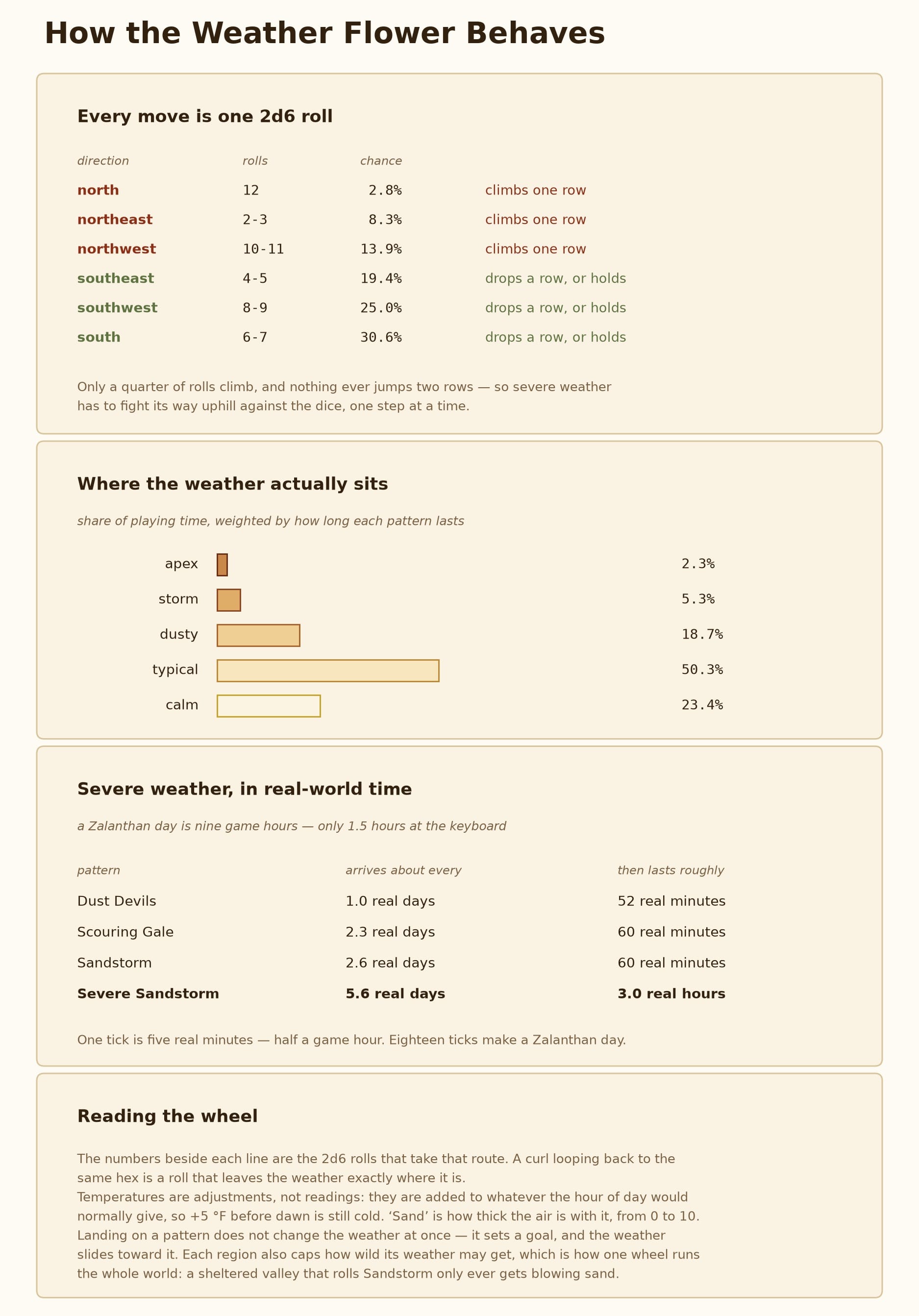
About every real-life hour, the game rolls 2d6 and moves one step on the wheel: up a row into worse weather, down a row into calmer weather, staying on the pattern it's already in, or occasionally sliding sideways to a different pattern of the same severity. While staying in a pattern, it still rerolls the specific numbers, so Fair Skies might still fluctuate a bit while remaining within its parameters.
Seasons
Seasonal patterns can have an impact on the weather, most notably on the temperature. During Low Sun, the average temperature will be noticeably lower than the other two months of a Zalanthan year. Like border areas, this will not be an immediate change, but a gradual one as the year moves through its arc.
Future Systems: Prediction and Control
So what's the point and benefit to all this?
Because the game chooses patterns to work towards, it makes it possible for us to add systems for predicting short-term weather. This could be a skill that certain classes / subclasses get, or some kind of magick that an elementalist might gain access to. Someone with the ability to predict the weather might be able to say "I think we're going to get stronger winds by the end of the day", or maybe "It's probably going to get a lot hotter this afternoon".
It also gives us the opportunity to create weather controlling magick. A whiran (wind mage) might be able to cast a spell that sets the weather on a windier pattern. An elkrosian (magick of energy and storms) might influence the weather pattern to cause the dust and sand in the air to intensify into a storm over a few in-game hours.
Conclusion
Weather will generally be something that is a background element, with the peace occasionally interrupted by sandstorms. It goes a long way towards setting the mood of the game at times.