
The following is a summation based on an interview between Eurynomos and Nessalin from 4/17/26
–
Tales of Zalanthas is introducing a crafting system that is distinct and fresh compared to the ArmageddonMUD/DIKU model. At its core, the new system aims to be more flexible, user-friendly, and conducive to a collaborative crafting experience. We aim to accomplish this through having more general prototypes that items are based off, as well as crafting tags that items can sub in on, rather than requiring unique items to combine into another unique item.
This system still allows for unique items and tags for those items; if a recipe asks for a ruby, or a carru horn, or a dujat tooth. It's far more flexible and no longer requires unique item id's to function as it did in DIKU.
We are pursuing some crafts/craft skills utilizing asynchronous crafting that allow for more flexibility and potential cooperation among crafters of different fields of focus. These would be a sort of 'set it and forget it' version of crafting, where low-level components of higher-grade crafts can be made and set on a timer and used when complete.
The Power of Craft Tags
The most fundamental change lies in the "craft tag." Instead of relying on unique item IDs, every item in Tales of Zalanthas can possess one or more of these tags. This allows the game to understand an item's inherent properties, rather than its specific identity or unique ID tag #.
You will no longer need to hunt down very specific items to make non-specific recipes.
For example, a red fruit might have the tags 'raw_red_fruit' and 'raw_fruit' allowing it to be used in recipes that require red fruit or others that only require fruit. Players can even query the system directly about an item's potential uses, receiving a list of all applicable recipes. This contrasts sharply with the older ArmageddonMUD system, which required precise combinations of specific item IDs.
Streamlined Player Experience
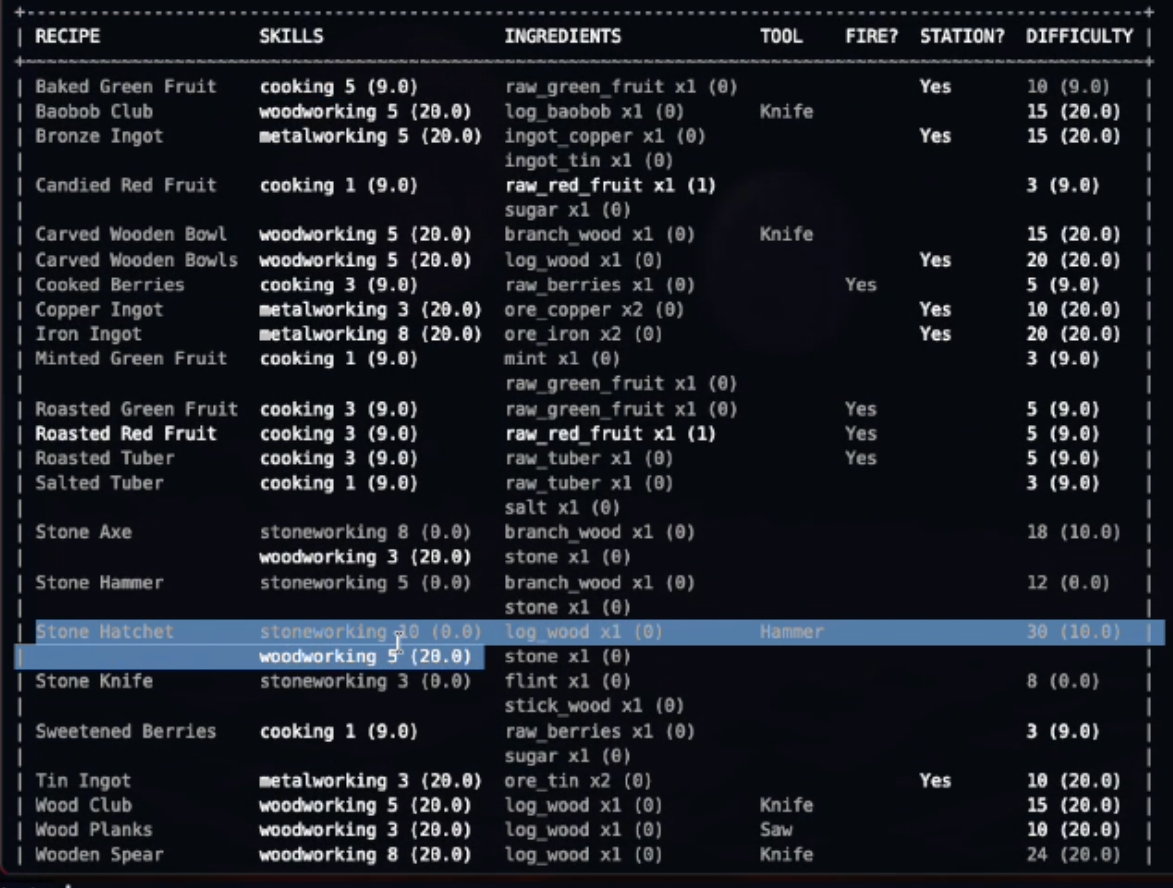
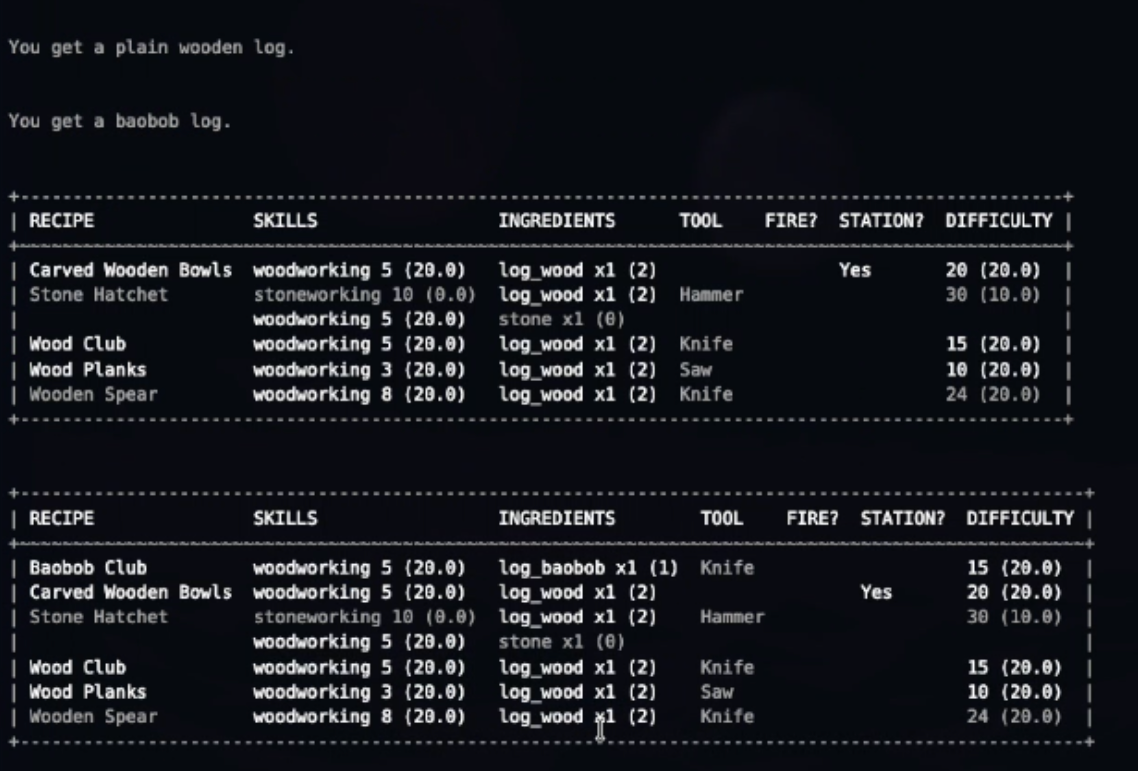
From a player's perspective, the crafting interface is designed for clarity. Recipes are presented in straightforward terms, detailing required skills, ingredients, tools, conditions, and difficulty. If a recipe's requirements are met, it will be fully highlighted, indicating readiness for creation. If some conditions are met, those will be highlighted, while what is not present will not be highlighted.
The system provides clear numerical feedback on a player's current abilities and resource availability. We hope this makes the system less opaque and more accessible to new players and a useful tool for players more familiar with the crafting system.
We also introduced a craft recipe requiring more than one skill to complete, which wasn’t possible in ArmageddonMUD.
Material Flexibility and System Growth
The craft tag system expands the utility in handling materials. The distinction between a broad tag like log_wood and a specific one such as log_baobab grants flexibility. Recipes can call for either a general wood log or a particular species, especially when the ingredient/type of ingredient is highlighted.
As Nessalin notes, "If we add a new tree type, we just give it the log_wood tag, and it immediately works with all existing wood recipes." This eliminates the need to painstakingly integrate new materials into every existing recipe, fostering more sustainable growth for the game long term. This adaptability is a significant improvement over older methods where each new material required explicit accounting.
It also allows for unique crafts/builds outside of the generic; if a new material is introduced and a player or staff member wants to write unique crafts specific to that ingredient, they can do that as well.
Skill, Difficulty, and the Learning Curve
While the system is designed to be accessible, mastery still requires effort. Each craft has a difficulty threshold that players must meet, influenced by their skill level, ingredient quality, and the tools or stations they employ. Skill is identified as the primary factor, while quality of the ingredient, quality of a tool used, all play in as secondary factors.
Players can also learn a recipe before they possess the proficiency to reliably execute it. This creates a natural progression where knowledge precedes complete ability, mirroring real-world learning. Recipes can be acquired through various in-game methods, including learning from other characters or discovering books.
We also haven't fully explored what it would take to achieve mastery in a crafting skill. We know that we want to avoid the 'master of all' sort of class like Merchant, and push people to choose mastery through sub-classes and decision making both at character creation and in-game choices/play.
The Role of Workstations
The crafting system also introduces a clear distinction between "in-hand" tasks and those requiring a dedicated "Work Station." Simple actions, like carving a bowl with a knife, can be performed directly. However, more involved processes necessitate a structured environment. Nessalin clarifies, "If it's not something you can reasonably do in your hands, it's going to probably require a workstation."
Workstations facilitate the production of reliable, repeatable components, which can then be assembled or refined by hand. This phased approach means success or failure often hinges on the final step, rather than every intermediate stage. For example, a workstation might yield a batch of five carved wooden bowls, while a player might craft a single bowl by hand.

You might also make intermediate components for a final product. For example, you might assemble the glued together pieces of a chair, and then finish it by hand off the work station – and final success is determined at this phase.
This also helps with RP surrounding craft; there was always the person making chairs in a tavern, which this helps mitigate. You might be able to whittle in the tavern or make anything that you could with two hands, but larger projects would need a dedicated work space/station to perform the work at.
Discovery and Knowledge Dissemination
For new players, the system aims for transparency through command feedback (craft list), recipe knowledge (ability to view all known recipes), and helpfile assistance.
PCs begin by exploring their known recipes, identifying necessary components, and then embarking on a journey to find them either through forage, trade, or hunting. The act of foraging would be highlighted in the helpfiles as a primary method of discovery, teaching players about the available resources firsthand.
Another significant departure from the ArmageddonMUD/DIKU model is the handling of knowledge. Crafting recipes are no longer primarily tied to clan membership or organizational access or OOC knowledge. Instead, they can circulate more freely, learned from books, other players, or through in-game discovery. This shift promotes a more open exchange of knowledge within the player community. While recipes still need to be learned, the boundary for discovery is presented as a horizon rather than an impenetrable wall, encouraging exploration and collaboration.
You might for example know you need a specific ingredient – you might discover outside or inside of the game that you need that ingredient. But your PC still has to go and find that ingredient, whether through foraging, trade, or exploration and hunting. This is another attempt to dispel the need for 'secrecy' when it comes to crafting and crafting recipes. The fun part is the pursuit of the ingredients and crafting them together, not discovering the recipe.
Asynchronous Crafting and Collaboration
A developing aspect of the new system is "asynchronous crafting," where complex tasks can unfold over time without demanding constant player attention. Smaller, immediate crafts are still "in-hand" actions. However, if a task "requires more than what you can reasonably hold and manage yourself," such as furniture making, smelting or large constructions/player housing components, it transitions to an asynchronous process.
This shift allows players to initiate a craft and then engage in other activities, fostering a different rhythm of play. It also hopefully encourages collaboration, as players can contribute to different stages of a larger project. For example – a hunter returns from the wastes with a heavy reptilian hide. They pass this to a tanner, who utilizes a specialized workstation to initiate the long, asynchronous process of curing and treating the skin. The tanner doesn't need to stand idle; they can engage in the social life of the city while the vats do the work. There will also likely be NPCs that help fill in the gap with some of these trades, similar to how tailors/resizing armor worked in ArmageddonMUD.
It also facilitates an apprentice/journeyman/master relationship, where an apprentice might be able to accomplish simple and repetitive tasks, and the master finishes the product. This leads towards shared workshops and collaborative endeavors, not through enforced rules or requirements of clan membership, but because it proves to be a practical and rewarding approach.
What types of crafting are you looking forward to exploring in Tales of Zalanthas?